

Merchant Console
Sell your API to agents in five steps
The Radius Merchant Console turns an API or MCP server into a catalog of priced endpoints that agents can pay for. You import an OpenAPI spec, set a price per call, and choose the wallet that gets paid.
- Import, price, get paid. Your OpenAPI spec becomes priced endpoints on one review screen, and payments settle to a wallet you register.
- The policy is the pricing engine. Prices live in a policy the platform serves. Four lines of SDK in your Worker fetch it every minute and enforce it on each request.
- An agent can run your pricing. Connect the Radius platform MCP server to Claude Code or another agent, and ask it to reprice endpoints from your traffic, once or on a schedule.
1. Create a project
A project is the catalog of endpoints or MCP tools you sell: one per API or MCP server.
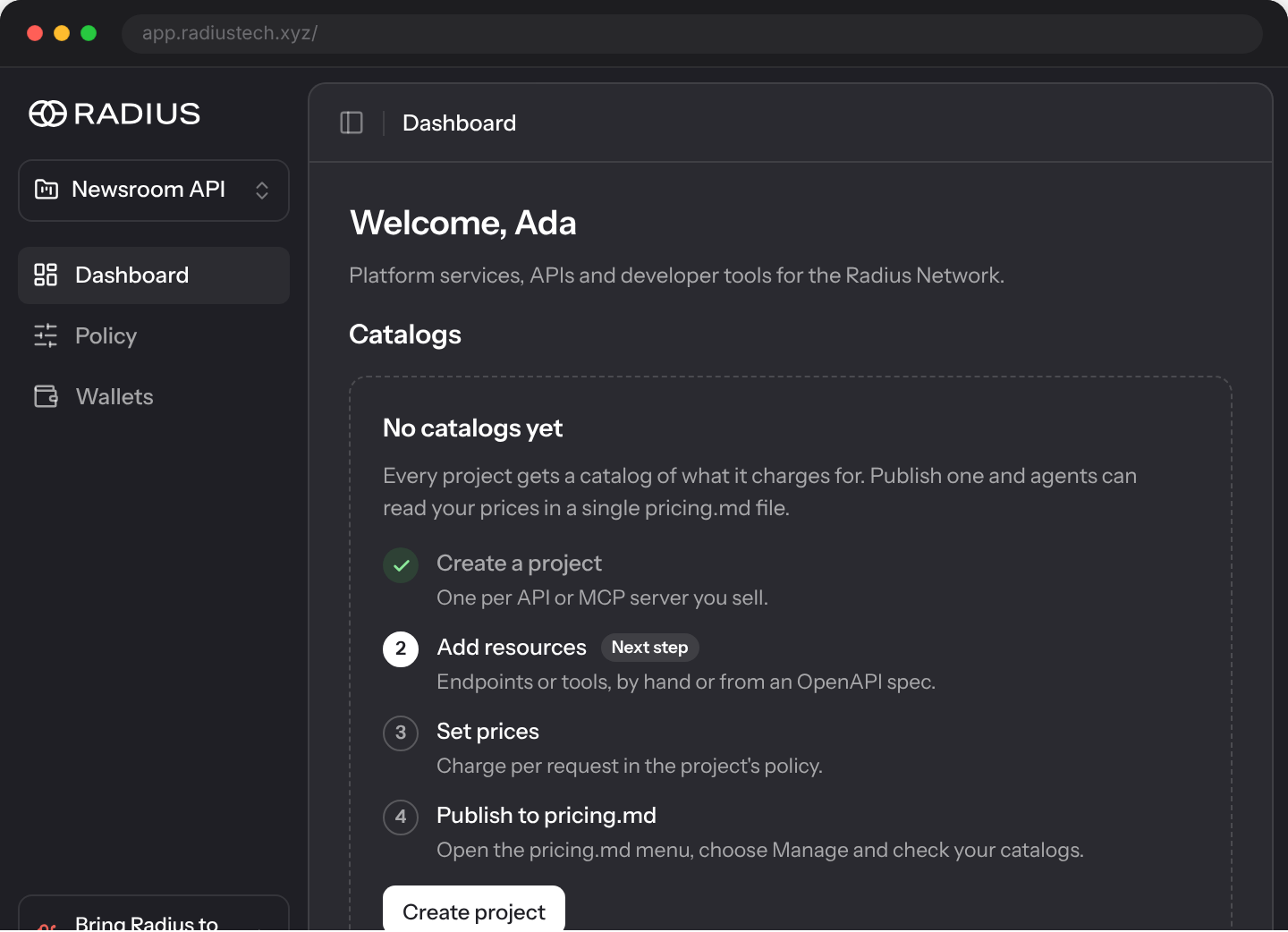
The empty dashboard lays out the whole path: create a project, add resources, set prices, and publish them to pricing.md so agents can read every price in one file. Creating the project moves the Next step marker to Add resources.
2. Import your OpenAPI spec
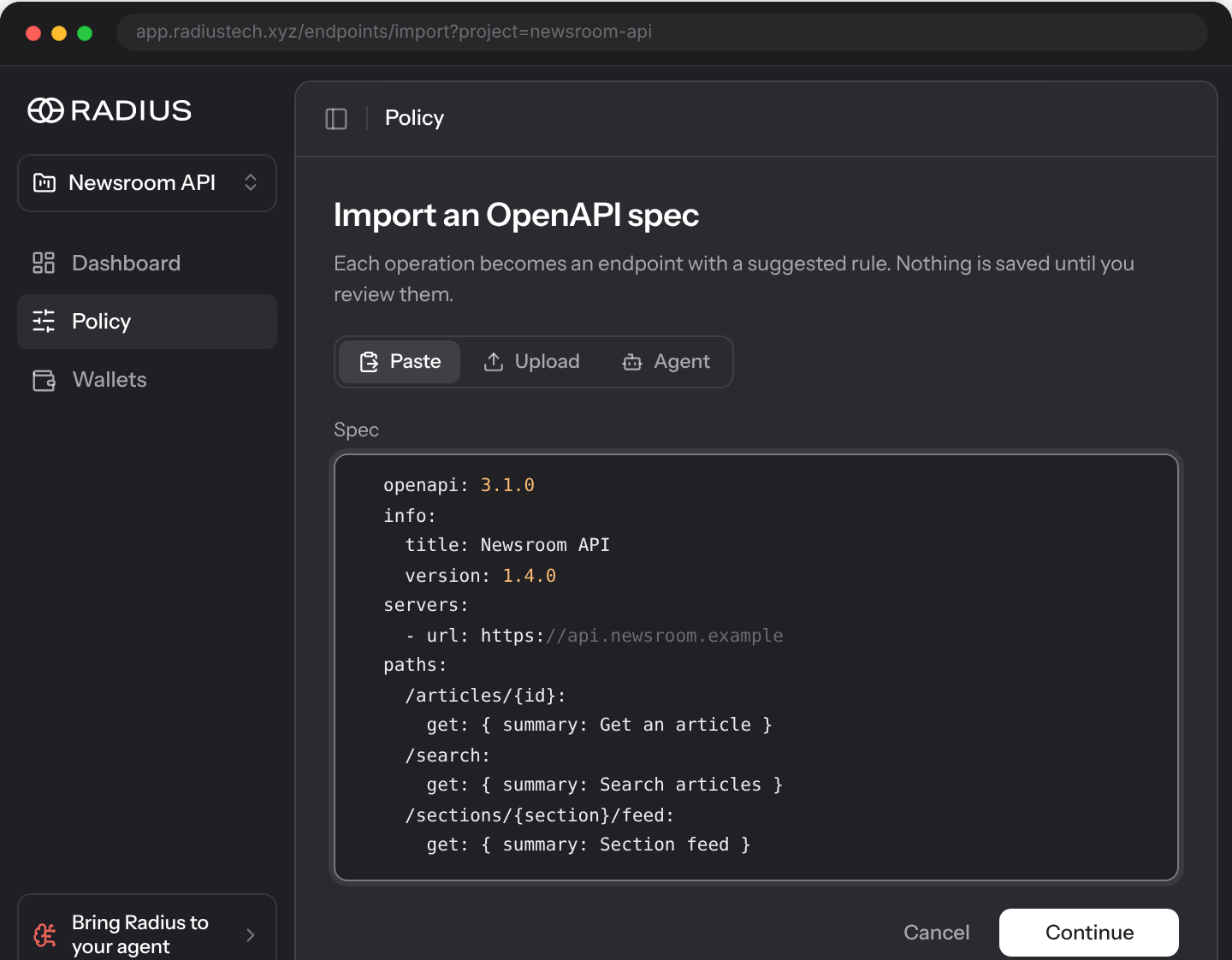
Paste or upload your OpenAPI definition on the Policy page. Each operation becomes an endpoint with a suggested rule: a charge for reads and writes, free for health checks. Nothing is saved until you review the endpoints. The Agent tab gives the same import as a prompt for an agent.
3. Choose starting prices and a payout wallet
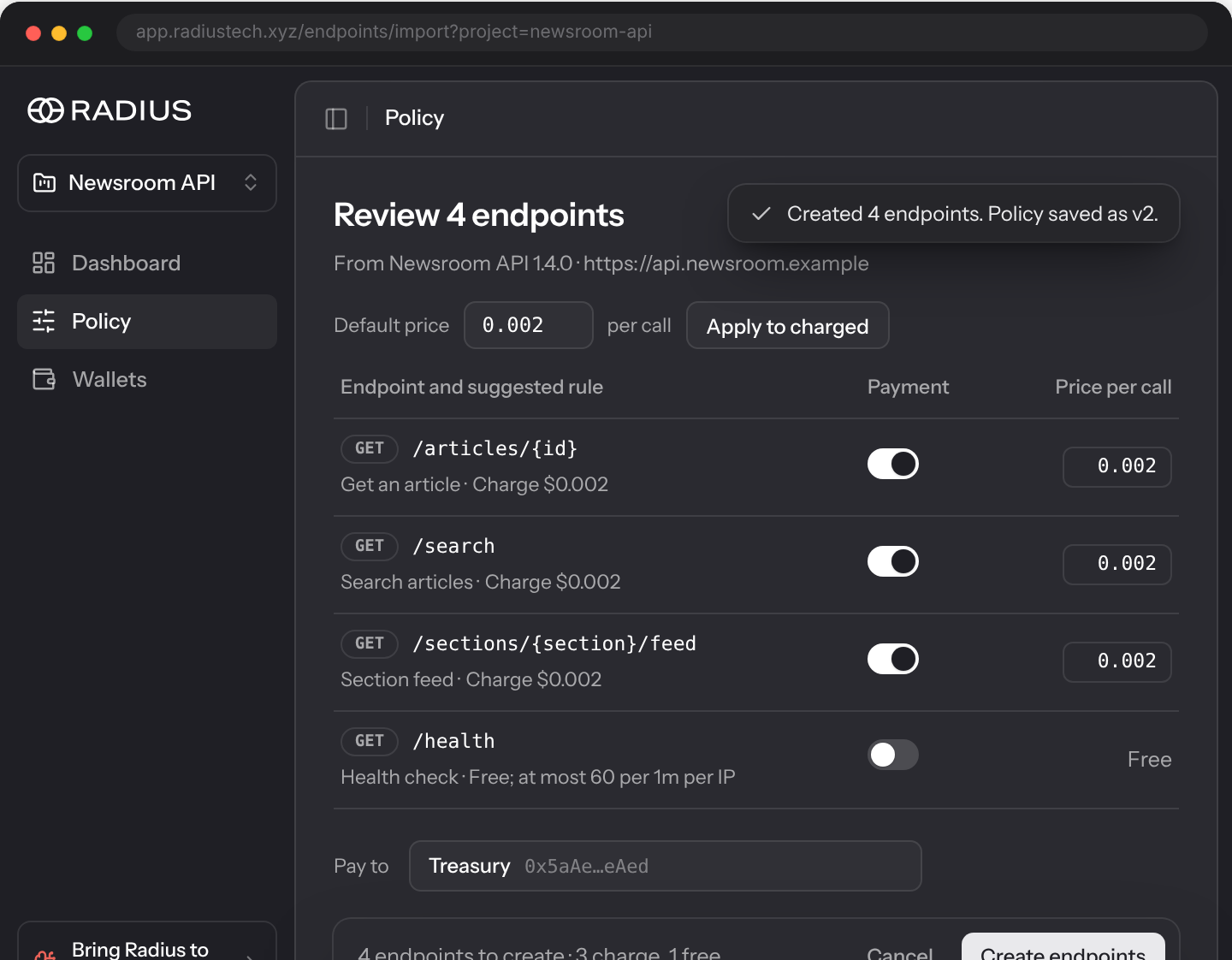
Set a default price per call, apply it to every charged endpoint, pick the wallet that gets paid, and create the endpoints. The console saves them as a new version of the project's policy.
These prices are starting points, not commitments. Prices are meant to move, closer to dynamic pricing than a rate card; step 5 shows how.
| Payout | Status |
|---|---|
| A wallet address you register (Wallets → Register wallet) | Available |
| Settlement to a bank account | Planned |
4. Enforce the policy in your Worker
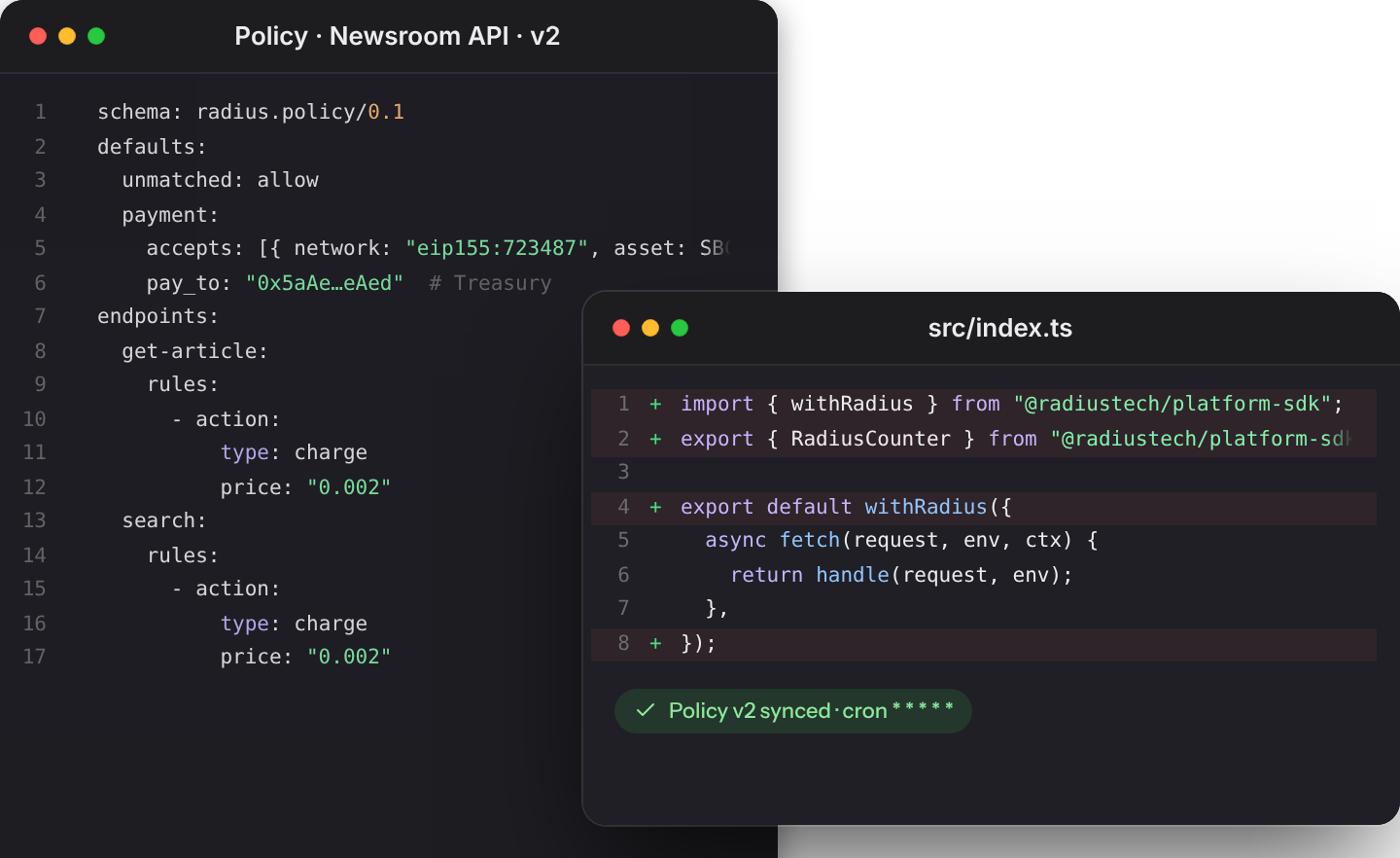
Your Worker pulls in the policy as a remote policy and enforces it on every request. The policy is a short document: who gets paid, which networks and assets are accepted, and one rule per endpoint.
withRadius from @radiustech/platform-sdk syncs the policy on a one-minute cron and allows, denies, rate-limits or charges each request over x402. A price change in the console or from an agent reaches the Worker without a deploy.
// src/index.ts
import { withRadius } from '@radiustech/platform-sdk';
export { RadiusCounter } from '@radiustech/platform-sdk/limiters/do';

export default withRadius({
  async fetch(request, env, ctx) {
    return handle(request, env);
  },
});
The Worker also needs:
RADIUS_PROJECT_ID, the project whose policy it enforces- An organization API key with
endpoints:read, as the secretRADIUS_API_KEY - A KV namespace bound as
RADIUS_POLICY - The
RadiusCounterDurable Object, bound asRADIUS_LIMITER
Hono apps use the radiusPolicy() middleware instead of withRadius.
5. Let an agent set the prices
Add the Radius platform connector to Claude Code or another agent, then ask in plain words.
claude mcp add --transport http radius-platform https://platform-api.radiustech.xyz/mcpThe agent signs in as you and acts with your permissions. It reads the current policy with get_policy and changes prices with update_endpoint; each change saves a new policy version that the Worker picks up within a minute.
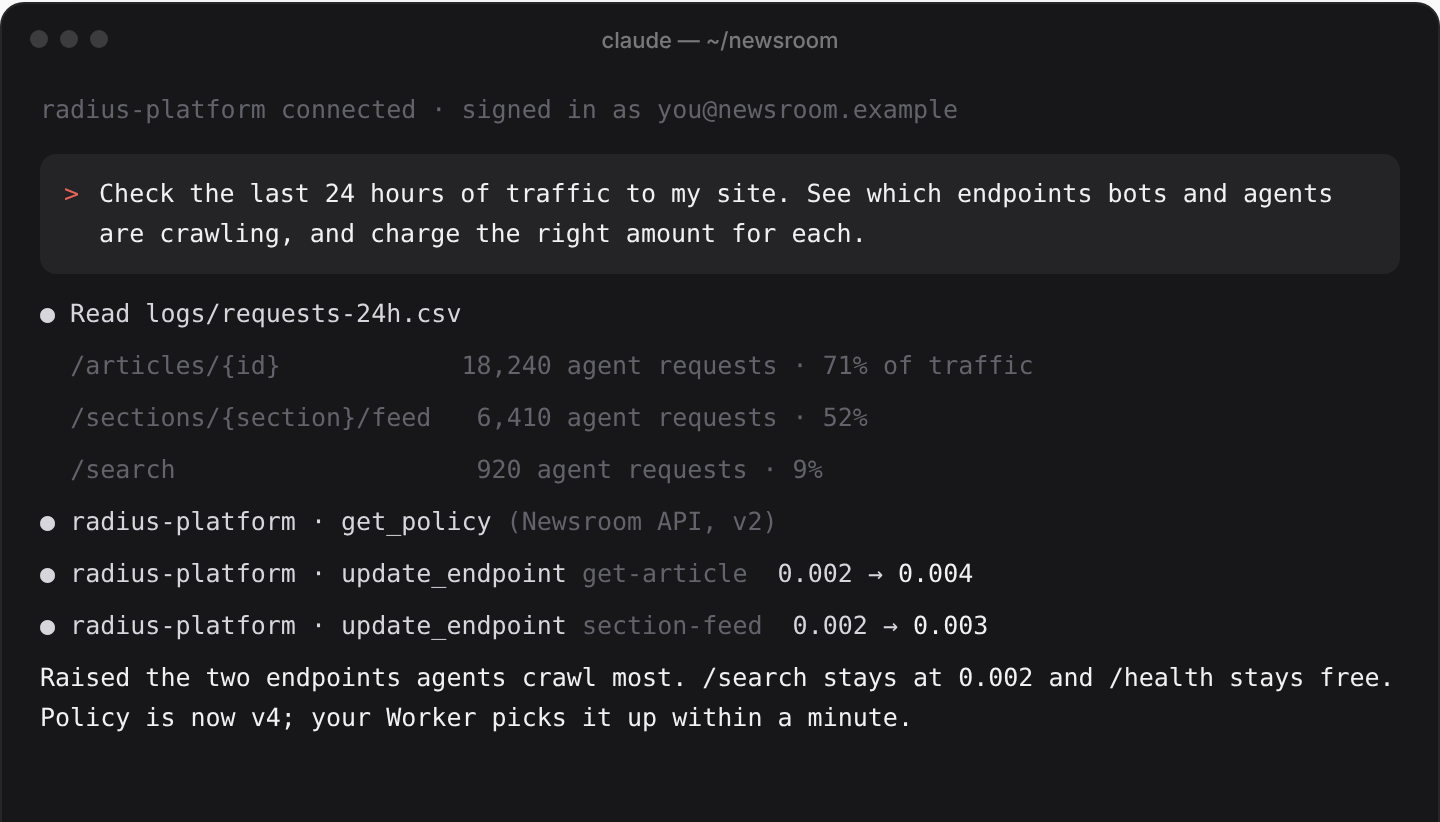
The platform's MCP tools manage projects, endpoints, policy, wallets and pricing.md. They don't serve traffic data yet, so the agent reads request counts from your own logs or analytics.
Run pricing on a schedule
The same request can run on a schedule, so pricing follows demand without anyone watching it:
- Read the last day of traffic from your logs or analytics: which endpoints bots and agents hit, and how often.
- Compare with the policy.
get_policyreturns the current rules and prices. - Reprice what changed with
update_endpointper endpoint. Each save is a new policy version you can review in the console. - Enforce without a deploy. The Worker syncs the new version within a minute.
Join the waitlist
Access to the Merchant Console is by waitlist. The waitlist is open at app.radiustech.xyz, and Radius is inviting early beta users now.
To learn how agents pay for a priced request, see accept payments and x402 payments.